ApplicationScenarios and Typical Cases of Rubber Shredding and Recycling Blades
1.Disposal of waste tires: Rubber shredding blades can crush tires into 5-20mm rubber particles, separate internal steel wires and fibers, and improve the recovery rate of rubber powder (recycled rubber raw materials).
2.Industrial rubber product recycling: For example, sealing rings, conveyor belts, etc., uniform crushing is achieved through multi blade design, which is convenient for melting, recycling or modified utilization.
3.Mixed waste treatment: For composite materials of rubber, plastic, and metal (such as cable sheaths), blades achieve component separation through a combination of shearing and tearing.
4.Production of rubber particles: Shredded rubber particles can be directly used for products such as plastic tracks and shock absorbers, with particle size accuracy controlled within ± 1mm.
5.Thermal cracking pretreatment: Tear up large rubber waste into 10-30mm fragments to improve pyrolysis efficiency and reduce energy consumption.
6.Urban waste treatment plants use four axis shredder blades to process household waste containing rubber (such as shoe soles and toys), and after crushing, sort and recycle rubber components.
7.Tearing and recycling of rubber waterproofing membranes from construction waste, with particles used for asphalt modification.
8.Waste car tires are centrally processed using 55SiCr material blades (highly wear-resistant) to crush them into rubber powder, which is used in the production of car parts such as soundproof pads.
9.Recycling of automotive sealing strips, customized cutting with irregular blades to preserve rubber elasticity.
10.Fine shredding of rubber components for electronic devices, such as keyboard pads and cable sheaths, with particle purity>95%, to meet high-precision injection molding requirements.
11.Industrial conveyor belt recycling, using combined blades to synchronously complete rough crushing and finishing, improving the quality of recycled rubber.
Comparison of Key Material Performance
|
Material
|
Hardness(HRC)
|
Wear Resistance
|
Impact Resistance
|
Applicable Scenarios
|
|
Cr12MoV
|
58-62
|
★★★★
|
★★★
|
Universal rubber and plastic recycling
|
|
SKD-11
|
60-64
|
★★★★★
|
★★★☆
|
High strength tires, industrial rubber blocks
|
|
ld steel
|
62-65
|
★★★★☆
|
★★★★
|
Mixed rubber containing metal impurities
|
|
hard metal
|
65-70
|
★★★★★
|
★★☆
|
Continuous operation, high load industrial scenarios
|
Core blade Types and Applicable Scenarios
|
Type
|
Design Characteristics
|
Applicable Scenarios
|
Material Recommendation
|
|
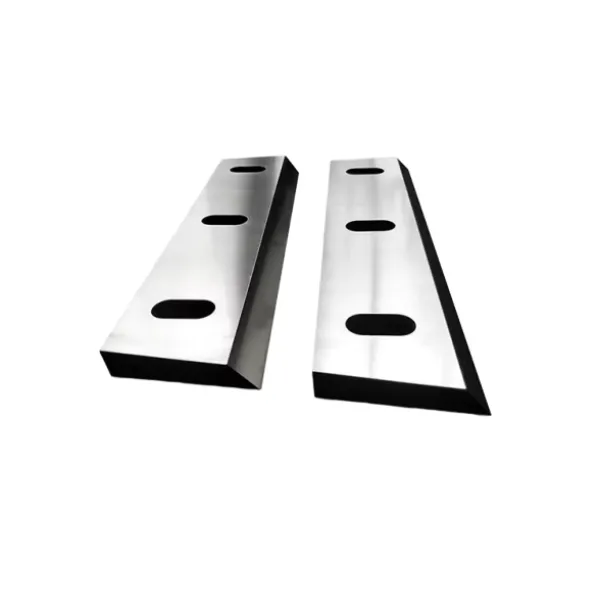
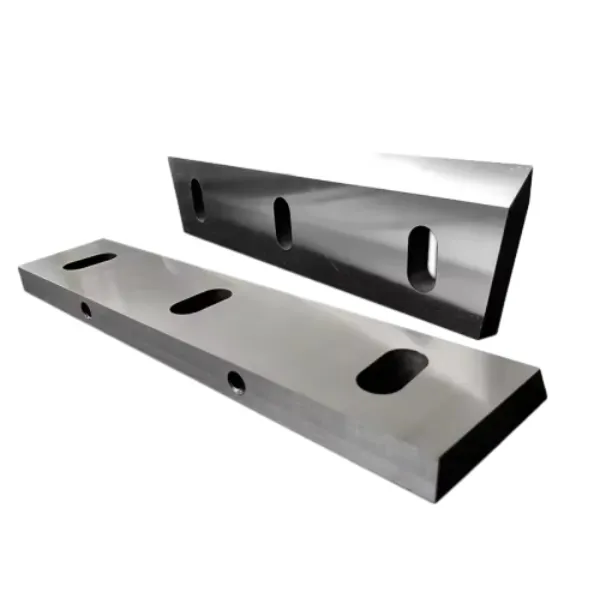
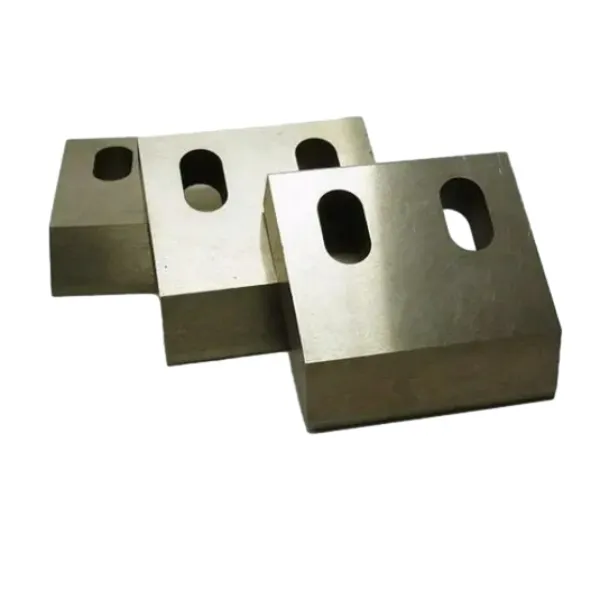
Single axis shredder blade
|
Square blade with curved edges on all sides, suitable for use with fixed blades and single axis shredders.
|
Small and medium-sized rubber recycling (such as tires and industrial waste) requires high particle uniformity.
|
Cr12MoV alloy steel (excellent wear resistance) or H13Ni (strong impact resistance).
|
|
Multi axis shredder blade
|
Circular blade with claws (3 claws, 8 claws, 12 claws), adjustable for shredding particle size through claw spacing, suitable for double/four axis shredders.
|
Efficient crushing of large volume rubber waste (such as whole tires and thick rubber sheets), with a processing capacity increased by over 30%.
|
Prioritize tool steel (9CrSi, 6CrW2Si), recommend mold steel (Cr12MoV, SKD-11, H13), special occasion alloy steel, high-speed steel
|
Typical Case
Waste tire crushing line: equipped with a four axis shredder and 55SiCr blades, the daily processing capacity of a single line reaches 20 tons, and the purity of rubber particles is>90%.
Industrial rubber seal recycling: Customized wavy blades for dual axis shredder, achieving dust-free crushing and particle uniformity of ± 0.5mm.
Mixed waste rubber treatment: The three-axis shredder blades synchronously shear metal and rubber, and the rubber recovery rate is increased to 85% after sorting.
By adapting blade materials, structures, and process parameters, rubber shredding and recycling blades can efficiently support circular economy and resource regeneration needs.
Material Recommendation
Ordinary rubber: SKD-11 or D2 tool steel (wear resistance preferred);
High impurity/metal mixed rubber: LD steel or hard alloy coating (anti chipping blade design).
Maintenance and Upgrade Suggestions
1.Daily maintenance
Cleaning: Use a high-pressure air gun to clean the melted rubber residue on the surface of the blade every shift to prevent adhesion and reduce cutting efficiency.
Lubrication: Add lithium based grease to bearings and gears every 50 hours to reduce metal fatigue wear.
2.Replacement cycle
Ordinary tool steel blade: 150-300 hours;
Hard alloy blade: 800-1200 hours.
The selection of rubber shredding blades requires comprehensive consideration of material characteristics (hardness, impurity content), and operating intensity (continuous/intermittent):
Economy type: Cr12MoV single axis blade;
Industrial grade: SKD-11 or hard alloy multi axis blade;
High impurity scenario: LD steel blade (anti chipping design).