Typical Applications
1.Wood processing and furniture manufacturing: Blades are used to cut logs into specific sizes of wood chips or lumber, suitable for scenarios such as board cutting and construction template processing in furniture manufacturing. Modern woodworking machinery improves production efficiency and product quality through high-precision cutting technology, supporting the demand for large-scale production.
2.Paper and pulp industry: The wood chips cut by blades are the main raw materials for pulp production. By adjusting the blade parameters, the size and thickness of the wood chips can be controlled to meet the requirements of the paper making process for material uniformity. Chipping machines usually work in conjunction with peeling machines and conveyors to form a continuous production line.
3.Manufacturing of artificial boards (particleboard, MDF, etc.): Cut wood chips are used as the base material for particleboard and MDF, and various types of boards are produced through hot pressing technology, which are widely used in the fields of construction and decoration. This process relies on the efficient crushing ability of the blade to process wood waste.
4.Biomass energy and power generation heating: Wood chips can be used as raw materials for biomass pellets for power plant generation or boiler heating, which is in line with the trend of sustainable energy development. The crushing treatment of tree branches and wood residues by blades improves resource utilization efficiency.
5.Recycling of forestry resources: Blades are used to treat residual materials after logging (such as branches and small diameter trees), cutting wood with a diameter of less than 200mm into craft wood chips to reduce resource waste and enhance economic value.
6.Horticulture and environmental protection coverage: Branches and leaves trimmed in households or gardens can be crushed with blades and used as soil cover to moisturize, inhibit grass growth, and beautify the environment.
7.Chipping machine blades are also used in textile and wood chip factories as core components for material preparation and processing.
Mainstream Material Classification
|
Material Type
|
Material Characteristics
|
Typical Applications
|
|
Alloy tool steel (SKD-11, Cr12MoV)
|
Using alloy steels such as SKD-11, Cr12MoV, D2, etc., after heat treatment, the hardness reaches HRC58-65, with excellent wear resistance, and can adapt to continuous slicing operations of high fiber wood such as pine and fir
|
Wood cutting machine blades (such as BX215/BX216 series), used for processing raw materials such as logs, branches, bamboo, etc
|
|
High speed steel (HSS) (W6Mo5Cr4V2)
|
Containing elements such as tungsten and cobalt (such as W6Mo5Cr4V2), with a hardness of HRC60-67, high temperature resistance (300-400 ℃), and strong impact resistance. Suitable for processing wood with knots or irregular shapes to reduce the risk of chipping
|
Crusher blades for processing hard miscellaneous wood, waste wood, and other scenarios
|
|
Hard alloy (tungsten carbide) (YG8-YG15)
|
Mainly in the YG8-YG15 series, cobalt content affects toughness (YG8 contains 8% cobalt and has stronger impact resistance); The hardness of tungsten carbide matrix exceeds 90HRA, with excellent wear resistance and a lifespan 5-8 times that of ordinary steel.
|
High precision planer blades for producing thin wood veneers, plywood veneers, etc
|
|
Carbon Tool Steel
|
High cost, mostly used for high load and high-precision slicing requirements
|
Simple slicer blade, used for rough processing of cork such as poplar and fir
|
Material Matching Principle
High load hardwood processing: Prioritize hard alloy (YG8-YG12) or high-speed steel, such as processing high-density wood such as oak and teak.
Cork/intermittent operation: Alloy tool steel (Cr12MoV) or carbon steel (T10) can meet the demand while considering cost
Structural Design
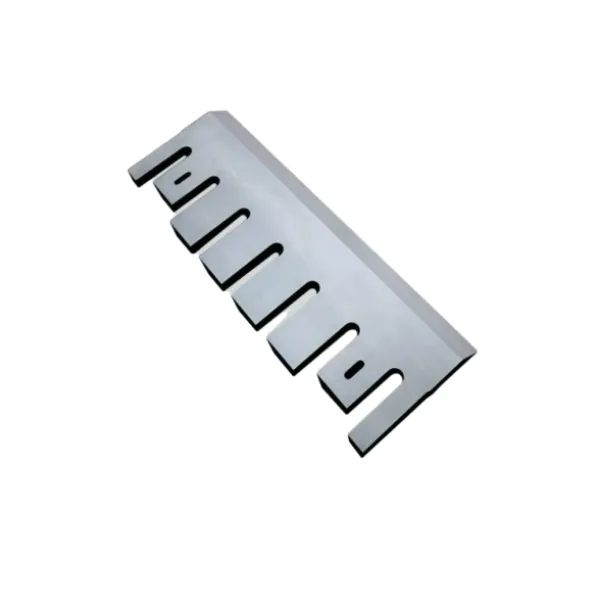
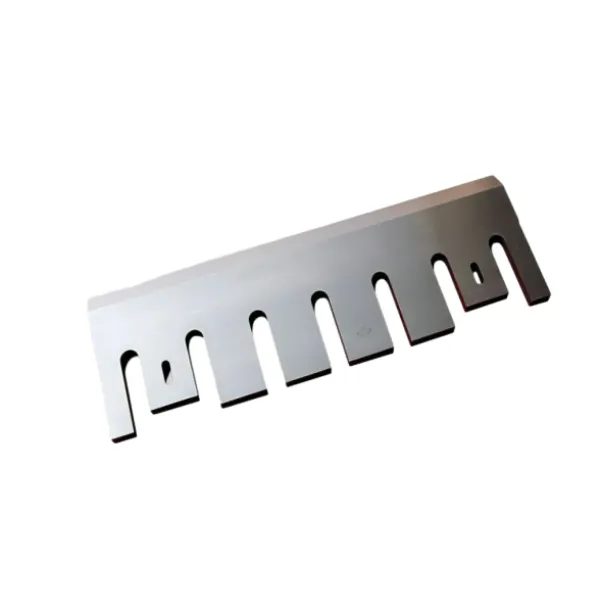
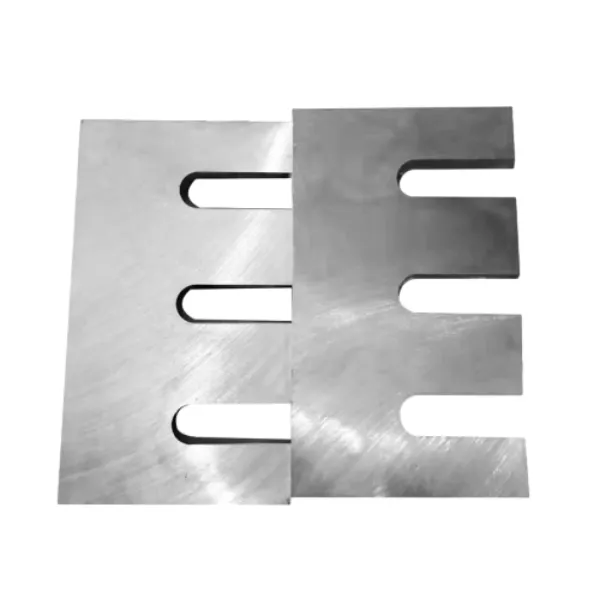
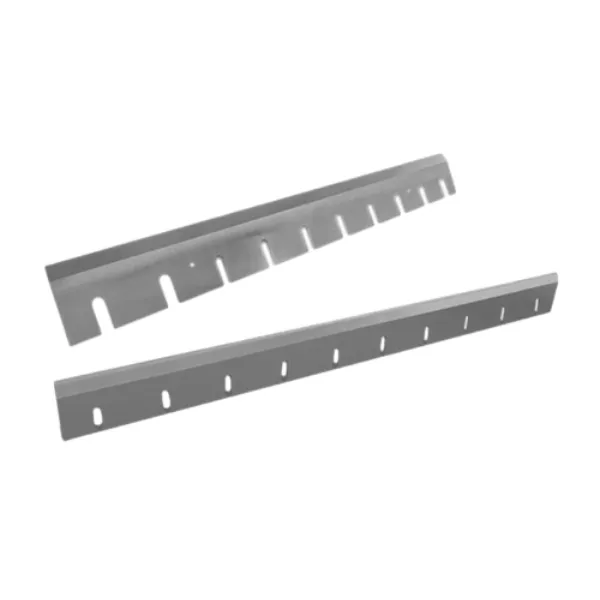
The shape design of the wood slicing machine blade directly affects cutting efficiency and finished product quality, and its structure needs to be adapted to different wood hardness, processing scenarios, and equipment types. The following are common shape classifications and characteristics:
|
Type
|
Characteristic
|
Application
|
Characteristic
|
|
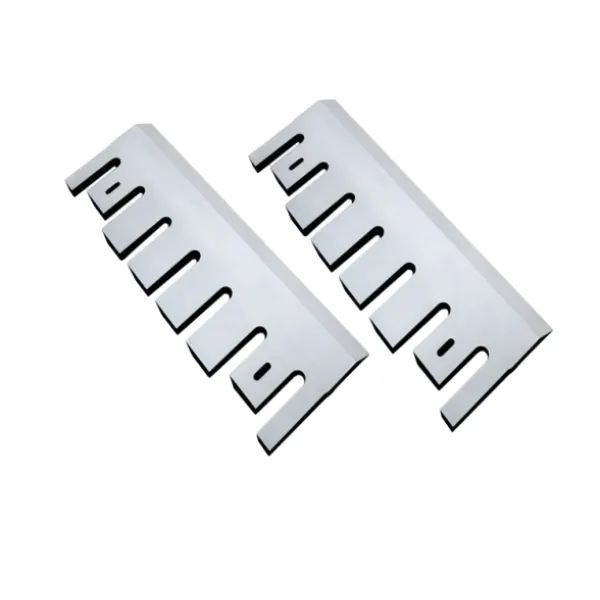
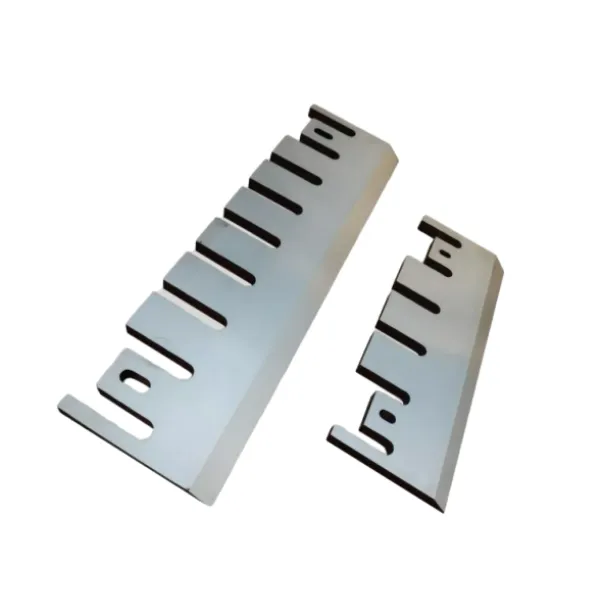
Drum type flying blade
|
Curved blade compatible with drum cutting machine, with densely arranged blade edges
|
Branch crushing, wood residue treatment
|
Specification: Common sizes such as 650 × 220 × 20mm, 910 × 220 × 20mm
|
|
Rotary cutting blade
|
Long strip blade, single-sided cutting, compatible with rotary cutting machine
|
Raw wood is spun into veneer for plywood production
|
Material: Cr12MoV or high-speed steel is commonly used to enhance wear resistance
|
Blade parameter optimization
Blade angle: Hard alloy blades are recommended to have a rake angle of 15 ° -20 ° to balance sharpness and wear resistance.
Thickness selection: When processing thin wood veneers, use ultra-thin blades of 0.8-1.5mm to reduce material loss.
Key Points For Shape Selection
Wood type: Hardwood is recommended with stepped teeth or ostrich back teeth, while cork is suitable for left and right teeth.
Cutting method: Cross cutting requires symmetrical tooth profile, while longitudinal cutting prioritizes the dorsal teeth.
Equipment matching: The drum cutting machine requires curved blades, and the push table saw is suitable for balancing the ladder teeth.
Durability: Extended replacement cycle for high-speed steel or SKD-11 material blades.
By selecting blade shapes and parameters reasonably, wood processing efficiency can be significantly improved, energy consumption and maintenance costs can be reduced.
Maintenance And Replacement
1.Daily maintenance
Regularly clean the surface of the blade with sawdust resin to avoid adhesion and increase in cutting resistance.
It is recommended to check the wear of the hard alloy blade every 200 hours and promptly repair or replace it.
2.Replacement cycle reference
Alloy tool steel blade: It needs to be replaced after about 150-300 hours of continuous operation.
Hard alloy blade: The lifespan can reach 800-1200 hours (depending on the hardness of the wood).
Summary: The blade of a wood slicer needs to be selected based on the hardness of the wood (pine/hardwood), processing accuracy (rough/fine cutting), and cost budget.