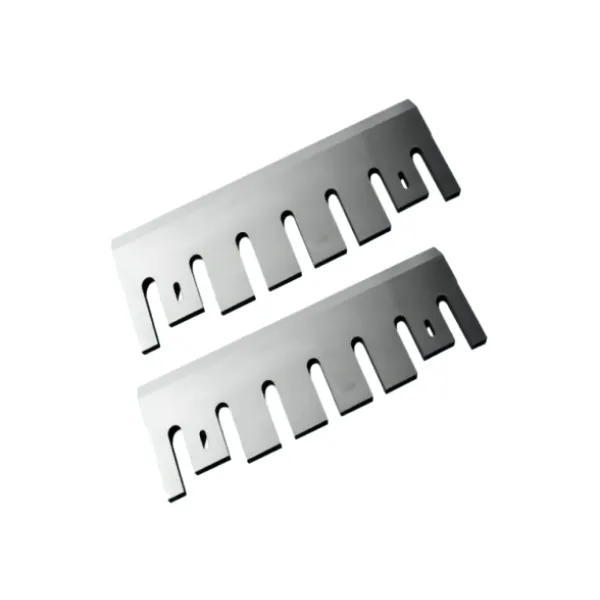
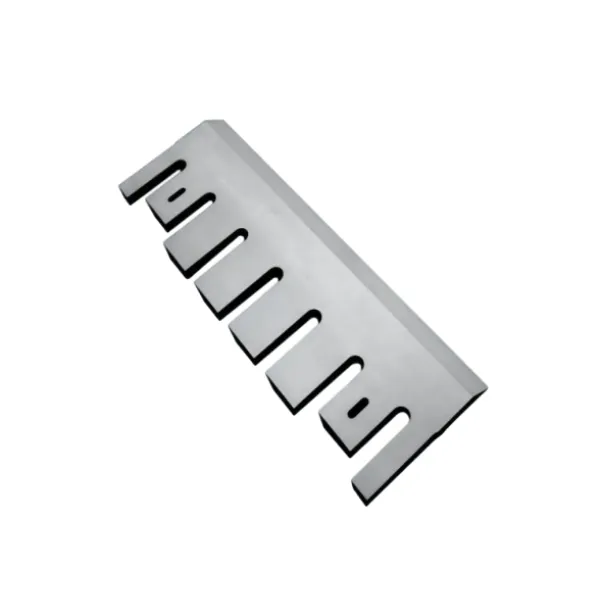
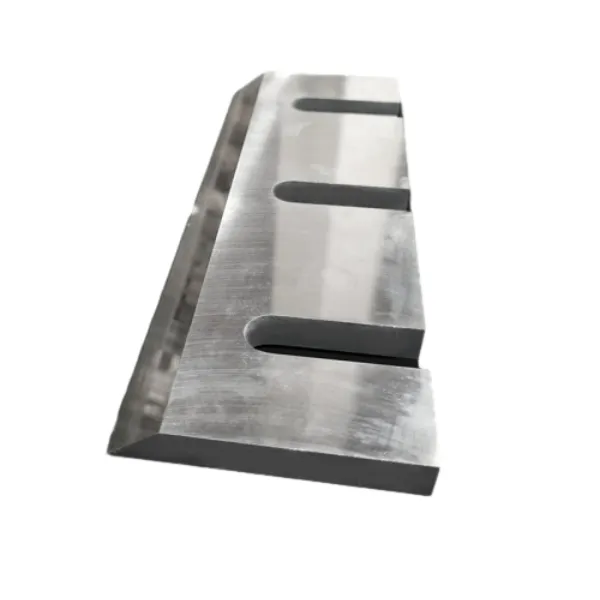
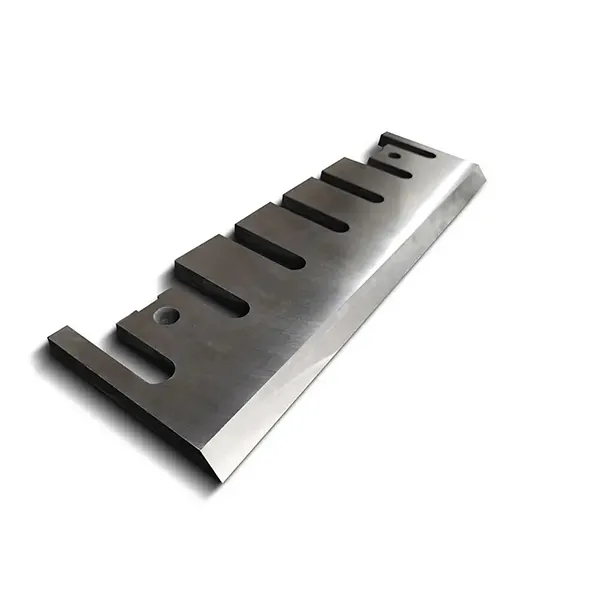
Main Application Scenarios And Technical Features:
1.Processing of logs and waste wood: Blades can process logs, branches, wooden boards, etc. into sawdust or wood chips for the production of particleboard, MDF, plywood and other boards. Waste wood (such as doors, windows, and furniture scraps) is crushed and converted into compressed boards, charcoal sticks, or mushroom culture media to improve resource utilization.
2.Paper making and biomass energy: Crushed wood chips are key raw materials for pulp production. By adjusting blade parameters, the particle size of wood chips can be controlled to meet the requirements of the paper making process. Wood chips are further processed into biomass pellets for use as fuel in power plants or heating in boilers, which is in line with the trend of green energy development.
3.Garden waste disposal: The crusher directly processes the entire tree branch and leaf without pre cutting, generating a cover for soil moisture retention, grass suppression, and environmental beautification. Fiber crops such as corn stalks and sorghum stalks can be used as livestock feed or organic fertilizer raw materials after being crushed.
4.Preparation of Edible Fungi Culture Medium: The sawdust cut by the blade has uniform particle size and is suitable as the core raw material for edible fungi (such as shiitake mushrooms and fungus) culture medium.
5.Material preparation for artificial board production: Small and medium-sized particle board and fiberboard enterprises use crushers to complete raw material pretreatment, supporting mobile operations and large-scale production. The production of high-density boards and sawdust boards relies on the efficient crushing ability of blades to ensure that the raw material particles meet the requirements of the hot pressing process.
6.Special material processing: The blade can process fiber materials such as bamboo and thatch, and expand to non-traditional wood processing fields such as weaving and handicrafts. For different hardness woods (such as pine, fir, and hardwood), the blade's wear resistance is improved through material optimization (such as alloy steel).
Shape Types Of Wood Crusher Blades
|
Shape
|
Structural Characteristics
|
Application Scenarios
|
Advantage
|
|
Toothed Blade (WT)
|
The blade edges are arranged in a serrated pattern, with sharp tooth tips and adjustable tooth spacing according to the material
|
Suitable for tearing and coarse crushing of fiber materials such as wood and branches, quickly decomposing long fiber structures through interdental biting force
|
When handling high toughness materials, it is not easy to entangle, reducing energy consumption and increasing production.
|
|
Crescent shaped blade (CT)
|
The blade has an arc-shaped design, resembling a crescent shape, which can generate continuous shear force.
|
Mostly used for fine wood crushing, such as sawdust processing, to evenly cut fibers to obtain fine particles.
|
Reduce material residue, improve product uniformity, and adapt to high-speed rotating centrifugal crushing mechanism.
|
|
|
The blade is straight and the structure is simple, often paired with symmetrically arranged double or multiple blade combinations.
|
Suitable for coarse crushing of hard wood or plastic, quickly breaking large pieces of material through direct impact force.
|
Low maintenance cost, easy replacement, suitable for scenarios with low requirements for crushing accuracy.
|
|
Straight blade (FT)
|
The blade head is thickened into a plate hammer shape and crushes the material through high kinetic energy impact.
|
Used for mixing and crushing (such as wood waste containing metal impurities), balancing impact and cutting effects.
|
Strong wear resistance, suitable for high-intensity operation of impact crushers.
|
|
Hammer shaped blade (BT)
|
Customize non-standard shapes according to special requirements, such as curved, elongated, or combination blades.
|
Adapt to the crushing needs of specific models (such as drum cutters) or special materials (such as bamboo and thatch).
|
Strong flexibility, can optimize the crushing efficiency for specific scenarios.
|
The wood crusher blade achieves full process coverage from coarse crushing to fine powder through collaborative design of shape and material, suitable for diversified scenarios such as wood processing, biomass energy, and environmental recycling.
Mainstream Materials And Characteristics
|
Material
|
Characteristic
|
Application
|
|
High speed steel (HSS)
|
After heat treatment, materials such as W6Mo5Cr4V2 have a hardness of HRC60-65 and strong impact resistance, suitable for crushing hardwood, jointed wood, and wet wood. Their wear resistance is increased by more than 30% compared to ordinary steel
|
Suitable for continuous processing of high fiber raw materials such as pine and fir wood.
|
|
alloy tool steel
|
KD-11, Cr12MoV and other materials have a hardness of HRC58-65, with moderate cost, suitable for small and medium-sized crushers to process cork such as pine and poplar
|
Wood sawdust machine, drum crusher base blade, supporting high-strength crushing needs
|
|
Hard alloy
|
Tungsten carbide matrix (YG8-YG15 series) has outstanding wear resistance and a lifespan more than 5 times that of high-speed steel
|
Suitable for high-precision planing or crushing of hardwood (such as oak and teak)
|
Suggestions for Blade Selection
Match materials by wood type
Cork/Wet Wood: Prioritize high-speed steel blades (such as BX216 model), combined with V-shaped blade design to reduce fiber entanglement risk.
Hardwood/composite materials: Choose hard alloy blades to meet the high-strength requirements of tracked crushers (processing diameter ≥ 35cm).
Material and Process Adaptation
Double layer composite structure: The blade is made of high-speed steel (such as SKD-11) to enhance wear resistance, and the blade body is made of alloy steel to ensure overall strength.
Surface treatment: Some blades extend their service life and reduce replacement frequency through nitriding or coating processes.
Equipment Adaptability
Small crawler machine (processing diameter ≤ 20cm): equipped with Cr12MoV alloy steel blades to meet the needs of urban greening and pruning.
Industrial grade crusher (processing diameter ≥ 35cm): requires a high torque power system and alloy blades to support the crushing of hard materials such as logs and building templates.
Key Points Of Operation And Maintenance
Installation and adjustment
When installing the new blade, the surface of the disc should be exposed by 3-4mm to ensure maximum crushing efficiency.
Regularly use a grinding machine to polish the cutting edge and restore its sharpness (it is recommended to maintain it every 200 hours).
Daily maintenance
After wet wood work, it is necessary to rinse the blades with a high-pressure water gun to prevent the adhesion of leaf flesh or resin.
Lubricate bearings, gears, and other parts every 50 hours to reduce wear.
Replacement Cycle Reference
High speed steel blade: It needs to be replaced after about 300-500 hours of continuous operation.
Alloy tool steel blade: with a lifespan of approximately 150-300 hours (depending on the hardness of the wood).
Wood crusher blades need to be selected comprehensively based on material characteristics (high-speed steel wear resistance, alloy steel economy) and operational requirements (wood hardness, humidity). Maintenance priorities include regular polishing, lubrication, and wet material cleaning. Hard alloy blades are recommended for industrial grade scenarios, and high-speed steel or alloy tool steel blades can be selected for small and medium-sized operations.